
By Alanis N..Cruz Soto
For a long time, I did not understand why my hair bothered me so much.
It was not just my hair. It was everything that came with it.
As a child in Puerto Rico, when I looked in the mirror, I saw a Black girl in a country where being Black often seemed to come with explanations. Explanations were needed about how I should wear my hair, how I should look, what colors looked good on me, what kind of hair was “beautiful,” and which kind was “difficult.” No one handed me a manual for being an Afro-descendant girl in Puerto Rico, but I learned the rules anyway.
I learned them by listening and watching.
—We have to improve the race.
That phrase appeared in family conversations as if it were ordinary advice. As if my skin were something that needed correction, implying that falling in love with someone lighter-skinned was a way of moving forward.
I also learned that there were different ways of being “Black” and some seemed more acceptable than others. There was the Black girl with “good” hair, the Black girl with “delicate” features, the Black girl with “sexy curves” etc. And then there was me, with hair that did not always want to cooperate, my features disproportionate given cultural nomrs, and anyway I have hip dips.
At school, during a time when I was practically the only Black student in the classroom while in primary school, being called “Black” was not necessarily an insult. It was a description, and because I was the only one, it was easy to point me out.
Until one day, someone decided to talk about my hair.
They compared it to a monkey’s hair.
I was too young to fully understand what that comment meant, but I heard and understood that, according to them, there was something wrong with the way my hair grew.
And those things stay with you.
They stay even when you pretend they do not matter.
My childhood was filled with contrasts. I lived in different places throughout Puerto Rico, and each one seemed to teach me a different version of the country.
In Toa Baja, on Puerto Rico’s north coast, I got to know the neighborhood, the old concrete houses, the enormous “jungle” behind my house, and the conversations and arguments that could be heard from the balcony. Although I was still within the metropolitan area, I became aware that Blackness and textured hair were not always openly celebrated or discussed as important parts of Puerto Rican identity. In Cataño, which is next to Puerto Rico’s capital, San Juan, I spent a great deal of time with my family. There, I experienced another metropolitan environment where conversations about race and hair were often present indirectly, through comments about appearance, beauty, and what was considered “presentable.” In Carolina, just a short distance from Cataño, I encountered a completely different environment, one where money, appearance, and skin color seemed to carry a different kind of weight. I became more aware of how colorism could intersect with social class and ideas about beauty. Then I moved to Bayamón, just a few minutes away from the capital, where I finally felt something resembling stability. Even there, however, being in the metropolitan area did not necessarily mean that Afro-Puerto Rican identity was openly celebrated or centered. I later became more aware that this experience was not the same throughout Puerto Rico; places such as Loíza, with its strong Afro-Puerto Rican cultural traditions, offered a different example of how Black identity, music, and heritage could be made more visible and openly celebrated.
But there was one place that always made me feel free: the beach.
Even today, when I think about who I am, I think about the sea.
I love the beaches on the western side of Puerto Rico, on the opposite end of the island from where I lived. I like driving there, watching the landscape change, and feeling that, for a few hours, I do not have to prove anything to anyone. I like the warmth of the sun on my skin, the salt water, the wind messing up my hair, and that feeling that the body can simply exist.
Maybe that is why I have never been able to completely hate my hair.
Because there is something beautiful about letting it be.
The wind does not try to tame it.
Neither does the sea.
The sun does not look at my skin and decide that it should be lighter.
Nature does not ask me to change.
But accepting my Blackness did not happen overnight.
For years, I was surrounded by images that taught me, directly or indirectly, what I was supposed to consider beautiful. American movies. Advertisements. Social media. Characters I could not necessarily identify with. Even my education carried a distinctly Americanized and European perspective. I learned about many cultures, but not always about my own culture in Puerto Rico.
And that has consequences.
Because at school, we do not only learn mathematics, science, or history. We also learn which bodies matter, which cultures are placed at the center, which accents are accepted, and which physical characteristics receive praise.
I learned many things about the world before I learned enough about myself.
It was during adolescence that I began to question it.
I started reading more. Listening to reggaeton differently. Becoming more interested in Puerto Rico. Discovering Black artists, writers, and public figures I had never known about. Understanding that the history of my country included an African history that was often glossed over, as if it were merely a footnote.
And then I arrived at the University of Puerto Rico, Río Piedras Campus (IUPI) which is in San Juan , and had a new culture of inquiry.
IUPI allowed me to ask questions I did not even know I was allowed to ask.
There, I encountered people with experiences different from my own, professors who spoke about race, gender, class, sexuality, and identity. I found spaces where questioning what was established was not necessarily considered disrespectful, but rather part of learning.
And little by little, I began to understand that many of the insecurities I had believed were exclusively mine had a social history behind them.
I also began to notice something I had previously managed to overlook.
The comments.
“Light-skinned girls drive me crazy.”
“I like your hair, but it’s not like other Black people’s hair.”
“You’re very pretty for a Black girl.”
“Black people are more resilient.”
“Black women are supposed to have curves.”
Sometimes they are said as jokes.
Sometimes as compliments.
But just because something is said as a joke does not mean it does not carry a history.
Because what does it mean to tell a Black woman that she is beautiful for a Black woman?
Who decided that those two things had to compete?
Why does my hair have to be compared to another Black person’s hair to determine whether it is “good”?
Why does a Black woman have to be voluptuous to fulfill an expectation she never chose?
Over time, I understood that it is not always about an individual comment. It is about a system of ideas that we have learned to repeat. And because we have learned it, it means we can unlearn it.
And unlearning is also a form of education.
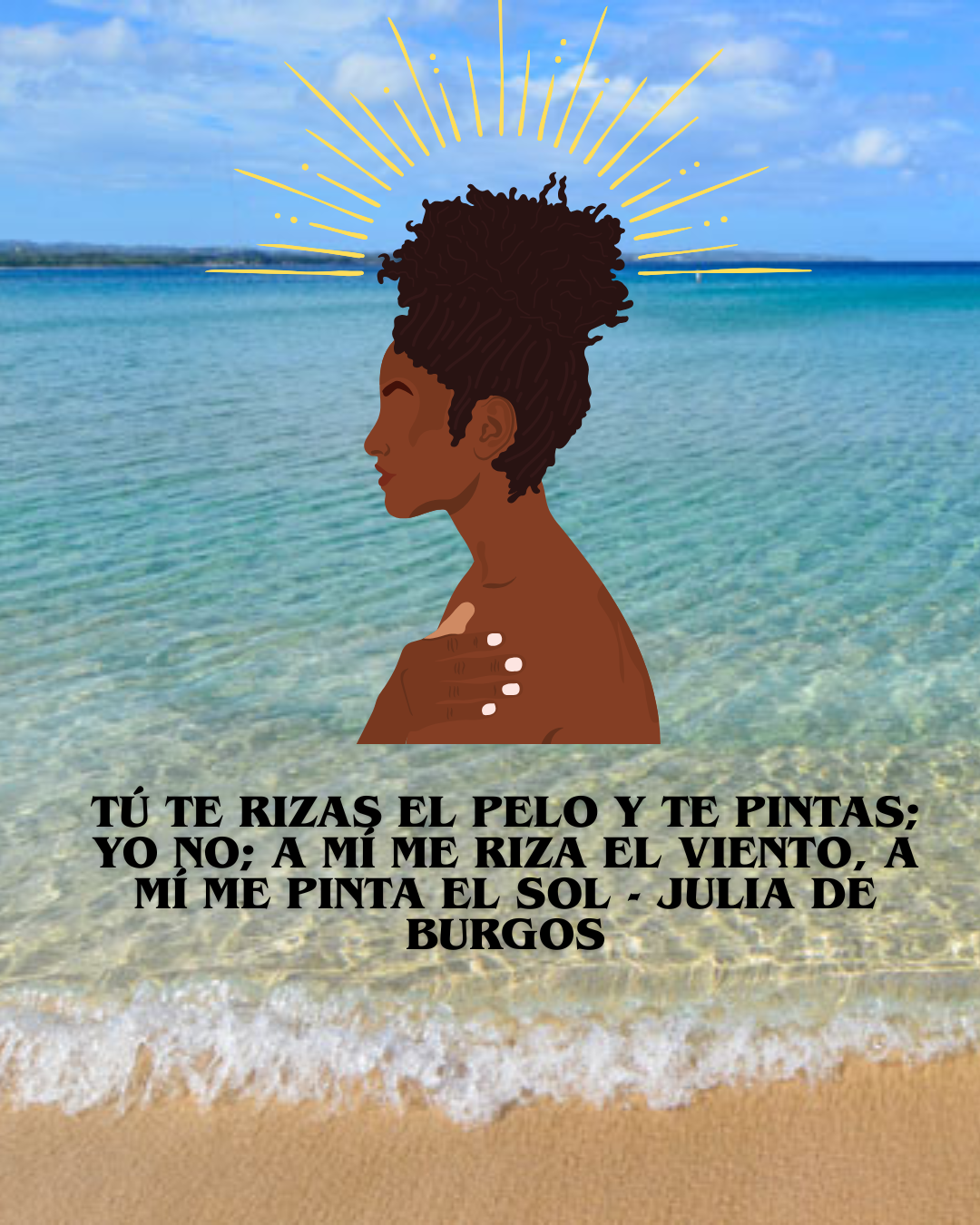
One day, I came across a line by the great Puerto Rican writer of the twentieith centura, Julia de Burgos that stayed with me:
“Tú te rizas el pelo y te pintas;
yo no; a mí me riza el viento, a mí me pinta el sol.”
Which translates to:
“You curl your hair and paint your face;
I do not; the wind curls my hair, and the sun paints my skin.”
The first time I read it, I thought about my afro.
Then I thought about my dark skin.
And finally, I thought about everything I had tried to change about myself in order to feel like I belonged.
Because my hair does not need to look like another woman’s hair to be beautiful.
My skin does not need to be lighter.
My identity does not need approval.
My Afro does not need permission.
My Afro is my crown.
Alanis N. Cruz Soto is a psychology student at the University of Puerto Rico, Río Piedras. Her interests center on social issues affecting women, particularly sexuality, behavior, vulnerability, identity, and the experiences of women within their social and cultural contexts. Her work is especially informed by an interest in understanding women’s experiences through psychological and social perspectives

Tony Waters is czar and editor of Ethnography.com. He came to us from the Sociology department at California State University at Chico where he has been a professor since 1996. In 2016 though he suddenly found himself with a new gig at Payap University in northern Thailand where he is on the faculty of the Peace Studies Department. He has also been a guest professor in Germany, and Tanzania. In the past, his main interests have been international development and refugees in Thailand, Tanzania, and California. This reflects a former career in the Peace Corps (Thailand), and refugee camps (Thailand and Tanzania). His books include: Crime and Immigrant Youth (1999), Bureaucratizing the Good Samaritan (2001), The Persistence of Subsistence Agriculture: Life Beneath of the Marketplace (2007), When Killing is a Crime (2007), and Schooling, Bureaucracy, and Childhood: Bureaucratizing the Child (2012). His hobby is trying to learn strange languages–and the mistakes that that implies. Tony is a prolific academic, you can read more of his work at academia.edu.or purchase one (or more!) of his books from Amazon.com.